

🧠 Odor Intelligence™ Executive Brief
Why Buyers Make Emotional Decisions Before They Ever Speak
⏱ Reading Time: 60 Seconds
If you've ever had buyers walk into a beautiful home and say,
"Something just doesn't feel right..."
there's a good chance they were responding to their sense of smell before they consciously recognized it.
Unlike your other senses, smell connects directly to the areas of the brain responsible for emotion and memory. That means buyers begin forming emotional impressions almost immediately after walking through the front door.
What Every Realtor Should Know
✔ Buyers often notice odors before they identify them.
✔ Pleasant environments help buyers focus on the home's features.
✔ Lingering odors from pets, smoke, moisture, or cooking can quietly influence first impressions.
Realtor Action
Before every showing, ask one simple question:
"What will buyers smell in the first 10 seconds?"
Now let's explore the science behind why that happens...
⬇️⬇️⬇️⬇️
Why Certain Smells Trigger Memories and Emotions
Imagine walking into a room and smelling fresh cinnamon rolls.
Before you even see them, you smile.
Now imagine walking into a basement that smells musty.
Almost instantly, you feel uncomfortable.
Nothing has happened yet—but your brain has already made a decision.
Why?
The answer is hidden inside your nose.
Your sense of smell is much more powerful than most people realize. Every day, your nose is constantly checking the air around you. It isn't just helping you enjoy flowers or your favorite meal. It's also helping protect you from danger, warning you about spoiled food, smoke, mold, and other things that may not be safe.
Even more amazing, your nose can unlock memories from years ago with just one breath.
Scientists have studied this connection for decades, and they've discovered that smell is the only sense directly connected to the parts of the brain responsible for emotion and memory.
That's why odors can affect how you feel before you even realize what's happening.
🌺Specialty Odor Removal
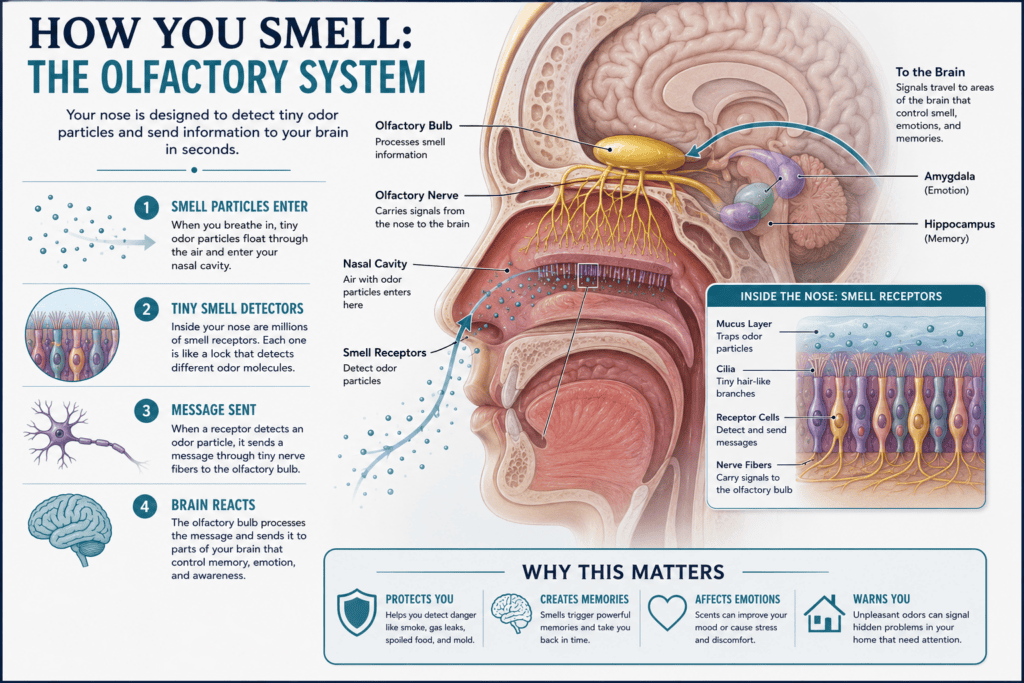
What Is the Olfactory System?
The olfactory system is your body's smell detection system.
Think of it as your body's own air quality detector.
Every time you breathe in, tiny odor particles float through the air and enter your nose.
Inside your nose are millions of special smell receptors.
These receptors are tiny cells designed to recognize different scents.
Some recognize food.
Others recognize flowers.
Some detect smoke.
Others recognize chemicals, mold, or even the scent of another person.
Once these receptors detect a smell, they immediately send an electrical message to your brain.
The entire process happens in less than a second.
That's faster than most people can blink.
Your Nose Is Like a Security Team

Imagine your nose as the front door of a building.
Standing at that door are millions of tiny security guards.
Every breath brings thousands of tiny scent particles into the building.
The security guards quickly inspect each one.
When they recognize something, they immediately call brain headquarters.
Some calls are good news.
"Fresh cookies!"
Others are warnings.
"Something is burning!"
Or...
"There's moisture and mold nearby."
Your brain doesn't wait around.
It reacts almost immediately.
That's why your first reaction to a smell often happens before you consciously think about it.
🌺Also Read How Smell Influences Home Buyers Within the First 30 Seconds | Patriot Odor Pros
The Brain's Smell Mailroom
After leaving your nose, the smell signal travels to a small structure at the bottom of your brain called the olfactory bulb.
The olfactory bulb works much like a mailroom.
Every smell that enters your nose first passes through this area.
The olfactory bulb sorts the information and decides where it needs to go next.
Some smells are sent to the part of your brain that recognizes what you're smelling.
Others are sent directly to areas that store memories.
Some trigger emotional responses.
Because this process happens so quickly, your feelings often appear before you've even identified the odor.
Why Smell Is Different from Your Other Senses
Your eyes...
Your ears...
Your skin...
All of these senses take a longer route through the brain before they reach the areas responsible for emotions.
Smell is different.
It takes a shortcut.
That shortcut leads directly to two important parts of your brain:
- The amygdala, which helps control emotions.
- The hippocampus, which stores memories.
This direct connection is why smell has such a powerful effect on how we feel.
It's also why one simple scent can instantly transport you back twenty or thirty years.
You don't have to try to remember.
Your brain does it automatically.
One Smell Can Tell a Whole Story

Think about some common smells.
Fresh-cut grass.
A campfire.
Fresh coffee.
Rain after a summer storm.
Pine trees at Christmas.
A new baby.
Each one probably reminds you of a specific place or time.
That's because your brain stores smells together with experiences.
When the smell returns...
The memory often comes back with it.
Scientists sometimes call this odor-evoked memory.
Most people simply call it "that smell reminds me of..."
Why Some Smells Make You Feel Uncomfortable
Not every smell creates happy memories.
Some odors make us nervous.
Others make us feel sick.
Some even cause headaches or stress.
There's a good reason for that.
Long before modern life, humans depended on smell for survival.
Rotting food often meant dangerous bacteria.
Smoke meant fire.
Standing water could mean disease.
Dead animals attracted predators.
Our brains learned that unpleasant smells often meant something was wrong.
Even today, your brain still reacts that way.
When your home has a persistent odor, your brain may stay on alert—even if you don't consciously notice it anymore.
That constant low-level stress is one reason people often describe a home with odor problems as feeling "uncomfortable" or "not quite right."
🚬Tobacco Smoke Odor Removal
🏡 Realtor Insight
Your buyers aren't judging the house.
They're judging how the house makes them feel.
Smell is often the very first emotional cue they receive.
Why Your Brain Stops Smelling Odors (and Why Other People Still Can)

In Part 1, we learned how your nose and brain work together to detect odors and create memories. We also discovered why certain smells can instantly make us feel happy, relaxed, or uncomfortable.
Now let's answer one of the most common questions homeowners ask:
"If I can't smell it anymore, why does everyone else still notice it?"
The answer is surprisingly simple.
Your brain is trying to help you.
What Is "Nose Blindness"?
Have you ever walked into someone's home and noticed a strong odor right away?
Maybe it smelled like pets.
Maybe cigarette smoke.
Maybe mildew.
But the homeowner said...
"I don't smell anything."
They probably weren't lying.
Their brain had simply stopped paying attention.
This is called olfactory adaptation, but most people know it as nose blindness.
It's your brain's way of ignoring smells that stay around for a long time.
🐈Pet Odor Removal
Your Brain Learns What Is Normal
Imagine moving next to a railroad.
The first week, every train wakes you up.
After a few months...
You hardly notice them.
The trains didn't stop.
Your brain simply decided they were normal.
The same thing happens with smells.
If an odor stays in your home day after day, your brain slowly turns down the volume.
Eventually, you stop noticing it altogether.
But someone visiting your home for the first time notices it immediately.
Their brain hasn't learned to ignore it.
Your Nose Never Stops Working
People often think they have stopped smelling because their nose stopped working.
That's not true.
Your nose is still collecting odor particles.
Your smell receptors are still sending messages.
What's changed is your brain.
Your brain decides the smell isn't important anymore, so it filters it into the background.
It's similar to wearing a watch.
At first, you feel it on your wrist.
After a while...
You completely forget it's there.
The watch didn't disappear.
Your brain simply stopped reminding you about it.
📈 Why This Matters
People remember how a home made them feel long after they forget square footage or paint colors.
Odors can become part of that memory—whether positive or negative.
Why This Can Become a Problem
Nose blindness is helpful when you're around harmless smells.
But it becomes a problem when the odor is warning you about something important.
For example:
- Mold growing behind a wall
- Pet urine soaked into the floor
- Water damage under carpet
- Cigarette smoke trapped in furniture
- Dead rodents inside walls
- Sewer gases
- Damp crawl spaces
These odors are often signs that something needs attention.
Ignoring them doesn't make the problem go away.
Air Fresheners Don't Fool Your Brain

Many people try to solve odor problems by spraying air fresheners or lighting scented candles.
At first...
The home smells better.
But here's what actually happens.
The bad odor is usually still there.
You've simply added another smell on top of it.
Imagine spilling garbage in a room.
Now spray vanilla air freshener.
Instead of smelling only garbage...
You smell vanilla and garbage.
Eventually, your brain starts ignoring the vanilla scent because it's new and harmless.
The original odor remains.
This is why many homes end up smelling like:
- Lavender and mildew
- Lemon and smoke
- Pine and pet odors
- Floral perfume and mold
Covering an odor is not the same as removing it.
Why Bad Smells Affect Your Mood
Most people think odors only affect their nose.
In reality, they affect the entire brain.
Remember the amygdala we talked about in Part 1?
That's the part of your brain that helps control emotions.
Because smell connects directly to it, unpleasant odors can influence how you feel without you even realizing it.
People living with chronic odors often describe feeling:
- Irritated
- Restless
- Embarrassed
- Tired
- Uncomfortable
- Unable to relax
Sometimes they don't realize the odor is contributing to those feelings until it's gone.
🏡Realtors: Before Your Next Showing
Five Quick Odor Checks
✅ Empty trash
✅ Remove pet bedding
✅ Open windows if weather allows
✅ Skip heavy air fresheners
✅ Walk through the home as if you were the buyer
The Hidden Cost of Living With Odors
Persistent odors don't just affect comfort.
They can also affect how others see your home.
Friends may visit less often.
Guests may notice something you can't smell.
Potential home buyers may walk away after just a few minutes.
Business customers may associate unpleasant odors with poor cleanliness.
Even though odor is invisible...
It creates a powerful first impression.
And first impressions are hard to change.
Why Professionals Look for the Source
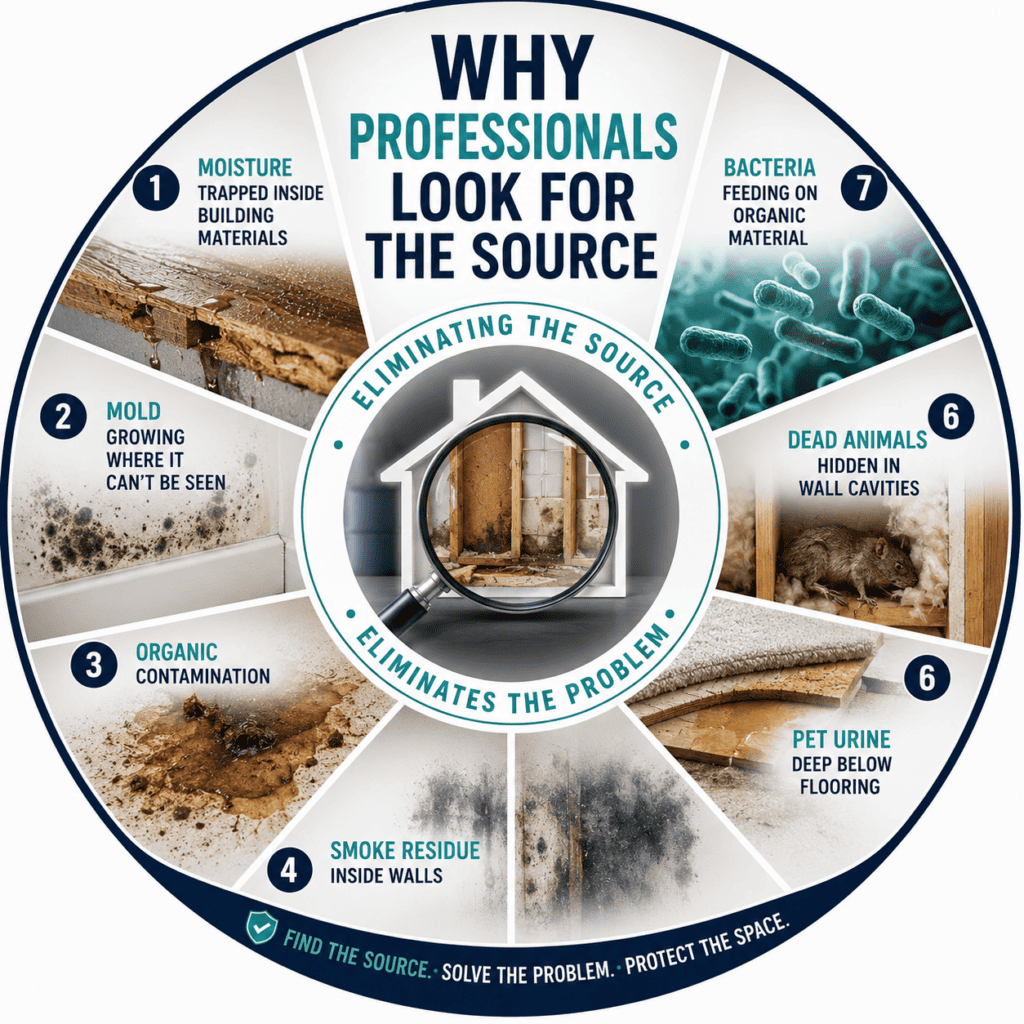
Professional odor removal is very different from simply making a room smell better.
Instead of asking,
"How do we cover this smell?"
Professionals ask,
"Where is this smell coming from?"
That question changes everything.
The source might be:
- Moisture trapped inside building materials
- Mold growing where it can't be seen
- Organic contamination
- Smoke residue inside walls
- Pet urine deep below flooring
- Dead animals hidden in wall cavities
- Bacteria feeding on organic material
Until that source is found and treated, the odor usually comes back.
That's why simply spraying fragrances, using foggers, or placing odor absorbers around a room often provides only temporary results.
Also Read 📙What Is a Mystery Odor? Understanding Specialty Odor Removal in Central Massachusetts
Finding the Cause Is the First Step Toward Fresh Air
Every odor has a story.
Some stories begin with a small water leak.
Others start with a forgotten food spill, a pet accident, smoke damage, or hidden mold.
The smell is simply your home's way of sending a message.
The goal isn't to silence the message.
The goal is to understand what it's trying to tell you.
When the source is identified and properly treated, the odor doesn't have to be hidden anymore.
It can finally be eliminated.
🚚Service Areas – Worcester, MA
Odors Are Tiny Particles

A smell isn't magic.
It's made up of tiny particles called odor molecules.
These molecules are so small that they float through the air until they land on something.
They don't just stay in the air.
They stick to surfaces all around your home.
Think of odor molecules like dust.
If dust settles on your furniture, you don't get rid of it by spraying perfume into the room.
You have to clean the furniture.
Odors work much the same way.
Where Odors Like to Hide
Some surfaces are smooth and easy to clean.
Others act like tiny sponges.
Materials that often trap odors include:
- Carpet
- Carpet padding
- Upholstered furniture
- Mattresses
- Curtains
- Drywall
- Wood
- Insulation
- Ceiling tiles
- HVAC systems
These materials have thousands of tiny spaces where odor molecules can settle.
The longer an odor remains, the deeper those molecules can work their way into the material.
Moisture Makes the Problem Worse
Water and odors often go hand in hand.
When building materials become wet, they can absorb even more odor molecules.
Moisture can also create the perfect environment for mold, mildew, and bacteria.
As these microorganisms grow, they produce their own odors.
That's why a home with a hidden leak may continue to smell musty even after the water has dried.
The moisture problem may be gone.
But the odor source is still there.
Also Read📙Why Do Vehicle, Boat & RV Odors Keep Coming Back | Central Massachusetts
Why Cleaning Doesn't Always Work
Many people clean the surface they can see.
But odors are often hiding beneath it.
For example:
You shampoo the carpet.
It smells fresh for a few days.
Then the odor returns.
Why?
Because the smell may actually be in the carpet pad below the carpet.
Or even in the subfloor underneath.
The surface was cleaned.
The source wasn't.
💦Musty & Mildew Odor Removal
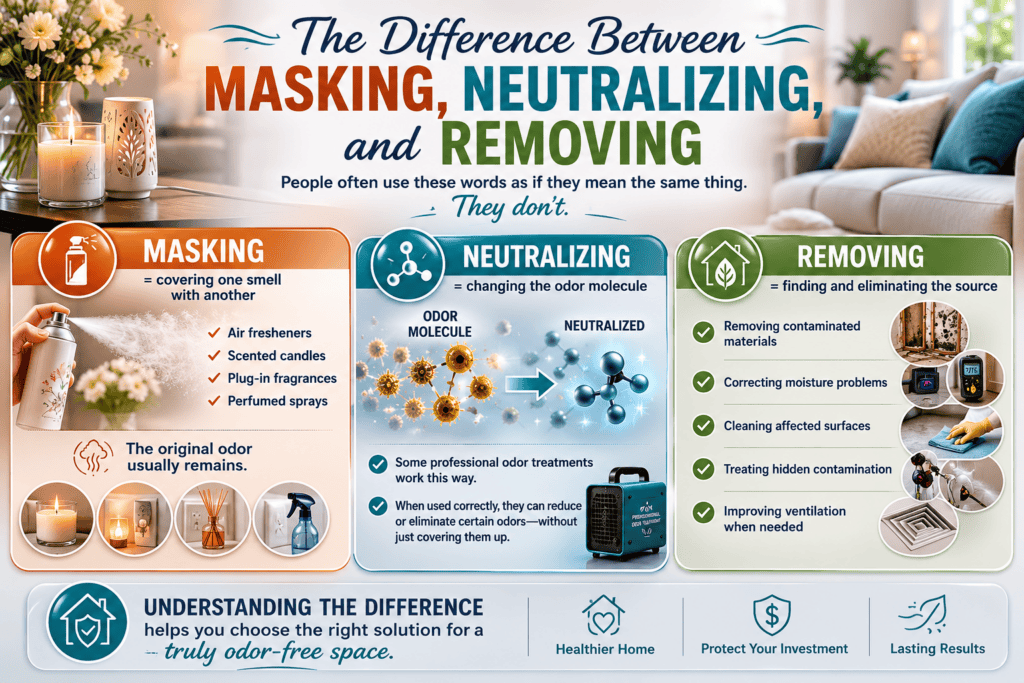
Every Odor Has a Cause
One of the biggest mistakes homeowners make is thinking odors simply "appear."
They don't.
There is always a reason.
For example:
A musty odor may point to excess moisture.
A sour smell could indicate bacterial growth.
A urine odor may have soaked into flooring.
A smoky smell may still be trapped inside walls or furniture.
The odor itself isn't the problem.
It's the clue.
Finding the cause is the first step toward solving it.
🏋🏻♂️Body & Locker Room Odors
Why Professional Inspections Matter
Some odor sources are easy to find.
Others aren't.
Professionals often investigate areas homeowners can't easily see, including:
- Behind walls
- Inside crawl spaces
- Attics
- HVAC systems
- Under flooring
- Inside cabinets
- Around plumbing
- Behind appliances
Sometimes the smell is coming from a place no one would expect.
Finding it takes experience, patience, and the right tools.
🏠Real Estate Professionals
A Fresh-Smelling Home Starts With Healthy Air
Most people want their homes to smell clean.
But a truly fresh home isn't created by adding fragrance.
It's created by removing the things that shouldn't be there in the first place.
When unwanted odors are gone, the air feels different.
Rooms become more comfortable.
Visitors notice.
Homeowners notice.
And often, people don't realize how much the odor affected them until it's finally gone.
What To Do Next...
Great Realtors understand that buyers purchase with emotion and justify with logic.
The science of smell reminds us that those emotions often begin before the first conversation—and before buyers consciously recognize why they feel the way they do.
Understanding that hidden influence can help every showing start on the right foot.
If a property has persistent odors that ordinary cleaning can't resolve, Patriot Odor Pros specializes in identifying the source and helping homes make the best possible first impression.

Your sense of smell is one of the most remarkable tools your body has. Every day, it helps you recognize familiar places, recall cherished memories, enjoy your favorite foods, and even warn you when something in your environment isn't right.
When an unpleasant odor lingers in your home or business, it's often more than just an inconvenience—it's a clue. Whether the source is hidden moisture, mold, smoke residue, pet contamination, or another environmental issue, the odor is your property's way of telling you that something deserves attention.
The good news is that persistent odors don't have to become a permanent part of your home. By understanding how odors work and, more importantly, by identifying their source, many odor problems can be resolved instead of simply covered up.
At Patriot OdorPros, we believe every odor has a cause—and every cause has a solution. Our approach isn't about making a room smell better for a few hours. It's about locating the source of the problem, identifying why the odor exists, and recommending the most effective solution for long-lasting results.
Whether you're a homeowner, property manager, or real estate professional preparing a home for sale, our team has the experience and specialized equipment to help uncover hidden odor sources that are often missed.
If your property has an odor that keeps coming back, don't just mask it—solve it. Contact Patriot OdorPros today and let us help you find the source, restore fresh indoor air, and give you confidence that the problem has been properly addressed.
☎️Contact Us / Get a Quote