

🧠 Odor Intelligence™ Executive Brief
⏱ 60-Second Summary
Primary Audience: Homeowners, Realtors, property managers, home professionals
Odor Intelligence™ Focus: Understanding what an unusual odor can—and cannot—tell you about a property
You walk into a freshly renovated home and immediately notice it:
That “new” smell.
Fresh paint. New flooring. New cabinets. New furniture.
What you're detecting may include airborne chemicals released from materials and products inside the home. Some of those chemicals belong to a broad category known as volatile organic compounds, or VOCs.
VOCs are organic compounds that can evaporate into the air under normal indoor conditions. Sources can include paints, coatings, adhesives, cleaning products, air fresheners, furnishings, building materials, fuels, and many other products. EPA notes that concentrations of many VOCs can be higher indoors than outdoors.
But here's where Odor Intelligence™ becomes important:
You cannot determine the safety of a home simply by how it smells.
Some VOCs have noticeable odors. Others may be difficult or impossible for people to detect by smell. And a powerful odor doesn't automatically tell you the identity, concentration, or health risk of the substance producing it.
For Realtors, the lesson is straightforward:
Treat an unexplained odor as information—not a diagnosis.
Investigate the source before making assumptions.
🏡 What Every Realtor Should Know
1. “New house smell” isn't necessarily a measure of cleanliness.
Paint, flooring, adhesives, cabinetry, furniture, cleaning products, and other materials can release VOCs into indoor air. EPA identifies building materials, furnishings, paints, cleaners, air fresheners and numerous household products as potential VOC sources.
2. Your nose isn't an air-quality instrument.
Odor tells you that your olfactory system detected something. It doesn't identify the chemical, determine its concentration, or establish whether the environment is hazardous.
3. Strong fragrance can create questions rather than eliminate them.
If buyers enter a property filled with plug-ins, sprays, candles, or other fragrances, they may wonder:
“What are they trying to cover up?”
📚 About the Patriot Odor Science Library
The Patriot Odor Science Library helps homeowners, Realtors, property managers, and other property professionals understand the science behind indoor odors.
Rather than treating odor as something that should simply be covered with fragrance, Patriot Odor Pros looks at the underlying question:
What is producing the odor?
Because every lasting odor solution begins with understanding the source.
Quick Navigation
- What Exactly Is a VOC?
- Why Are VOCs Called “Volatile”?
- Where Do VOCs Come From Inside Homes?
- Can You Actually Smell VOCs?
- Why Odor Strength Doesn't Equal Toxicity
- VOCs, Renovations and the “New House Smell”
- What Realtors Should Do When Buyers Notice an Odor
- Why Source Investigation Matters
Key Takeaways
🔬 VOCs are chemicals, not simply “bad smells.”
VOC describes a broad class of organic compounds capable of entering the air.
🏠 Homes contain many potential VOC sources.
Paints, cleaners, furnishings, building materials, adhesives, air fresheners, and other products can contribute compounds to indoor air.
👃 Your nose can detect some airborne compounds—but not all of them.
The absence of an odor does not establish that VOCs are absent.
⚠️ Strong odor does not automatically mean high toxicity.
Health risk depends on factors including the substance involved, concentration, frequency and duration of exposure—not merely how strong something smells.
🏡 Realtors should treat unusual odors as clues, not diagnoses.
An unexplained smell deserves investigation before assumptions are made about mold, chemicals, water damage, contamination, or other causes.
🎯 Source identification remains the objective.
Understanding what is producing an odor is more useful than simply covering it with another fragrance.
Read More
Estimated Reading Time: 11–13 minutes
⬇️⬇️⬇️⬇️
Your Home Has Chemistry Happening Inside It Right Now

Look around the room you're sitting in.
You probably see ordinary things:
Paint.
Furniture.
Flooring.
Cabinets.
Cleaning products.
Maybe an air freshener.
What you don't see is the chemistry occurring between those materials and the air around you.
Certain organic compounds can transition into the gas phase under ordinary indoor conditions and enter the air we breathe. Scientists commonly describe these substances as volatile organic compounds—or VOCs. EPA explains VOCs broadly in indoor-air discussions as organic compounds capable of evaporating under normal atmospheric conditions.
And they're hardly unusual.
They can originate from thousands of products and materials encountered in everyday buildings.
But here's where VOC science becomes particularly interesting for an odor company:
Some VOCs smell.
Some don't produce an odor people readily detect.
And odor intensity alone cannot tell you whether a compound represents a significant exposure risk.
That distinction matters.
Because when someone says,
“I smell chemicals in this house.”
they've made an observation.
They haven't made a chemical identification.
And they certainly haven't completed an indoor-air assessment.
Understanding that difference is the beginning of Odor Intelligence™.
🏠 Why This Matters in Real Estate
A Realtor doesn't need to become a chemist.
But understanding the basics of VOCs can prevent two very different mistakes:
Mistake #1: Assuming every unusual smell represents a dangerous chemical exposure.
Mistake #2: Assuming that because a home doesn't smell unusual, its indoor air contains no VOCs.
Neither conclusion is scientifically justified.
For real estate professionals, the better approach is:
Notice. Document. Investigate. Don't diagnose by smell.
Also Read 📖How Smell Influences Home Buyers Within the First 30 Seconds | Patriot Odor Pros
📊 Odor Intelligence™ Standout Element
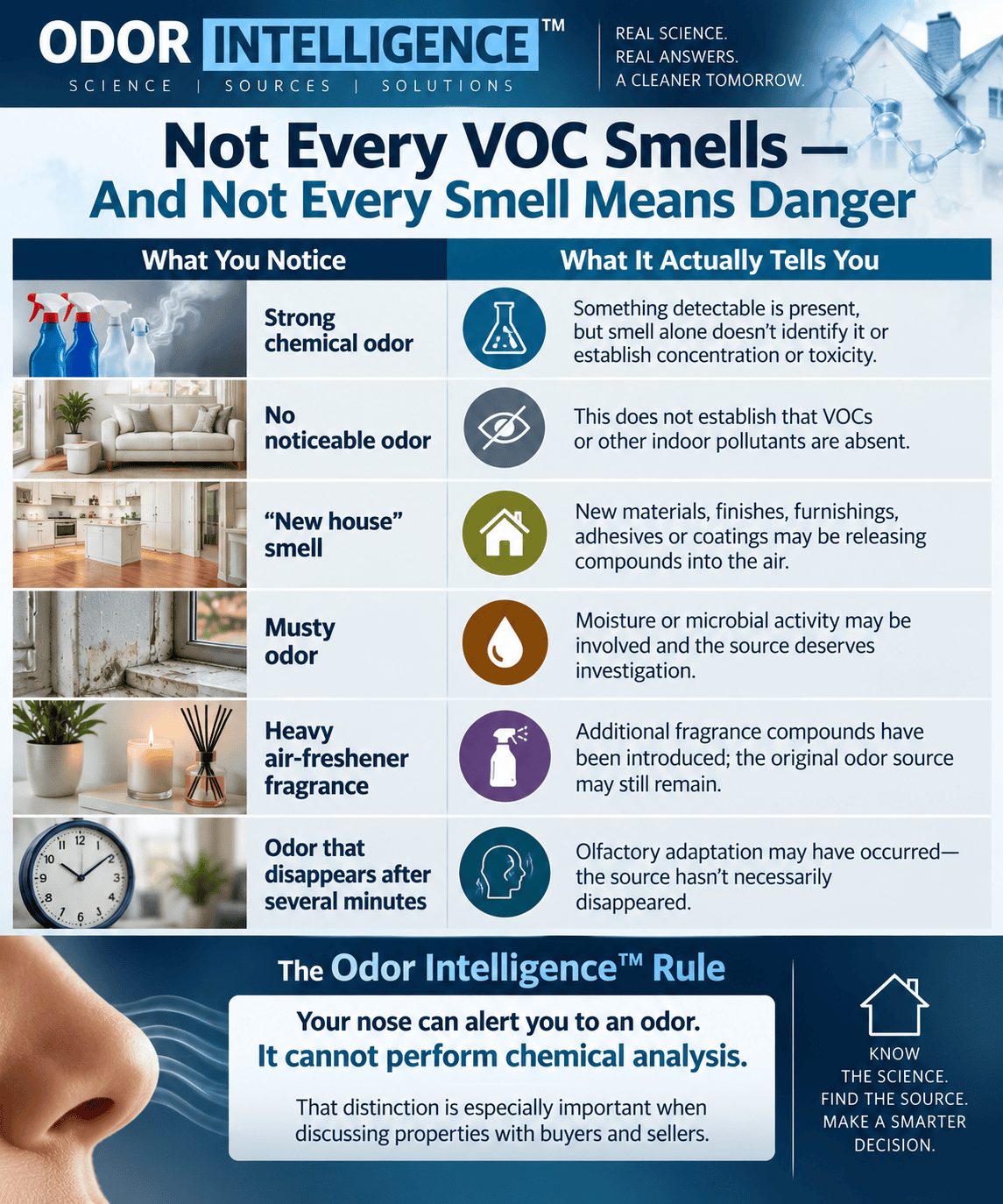
Not Every VOC Smells — And Not Every Smell Means Danger
| What You Notice | What It Actually Tells You |
|---|---|
| Strong chemical odor | Something detectable is present, but smell alone doesn't identify it or establish concentration or toxicity. |
| No noticeable odor | This does not establish that VOCs or other indoor pollutants are absent. |
| “New house” smell | New materials, finishes, furnishings, adhesives or coatings may be releasing compounds into the air. |
| Musty odor | Moisture or microbial activity may be involved and the source deserves investigation. |
| Heavy air-freshener fragrance | Additional fragrance compounds have been introduced; the original odor source may still remain. |
| Odor that disappears after several minutes | Olfactory adaptation may have occurred—the source hasn't necessarily disappeared. |
The Odor Intelligence™ Rule
Your nose can alert you to an odor. It cannot perform chemical analysis.
That distinction is especially important when discussing properties with buyers and sellers.
Also Read📖The Science Behind Scent and Emotion | Patriot OdorPros
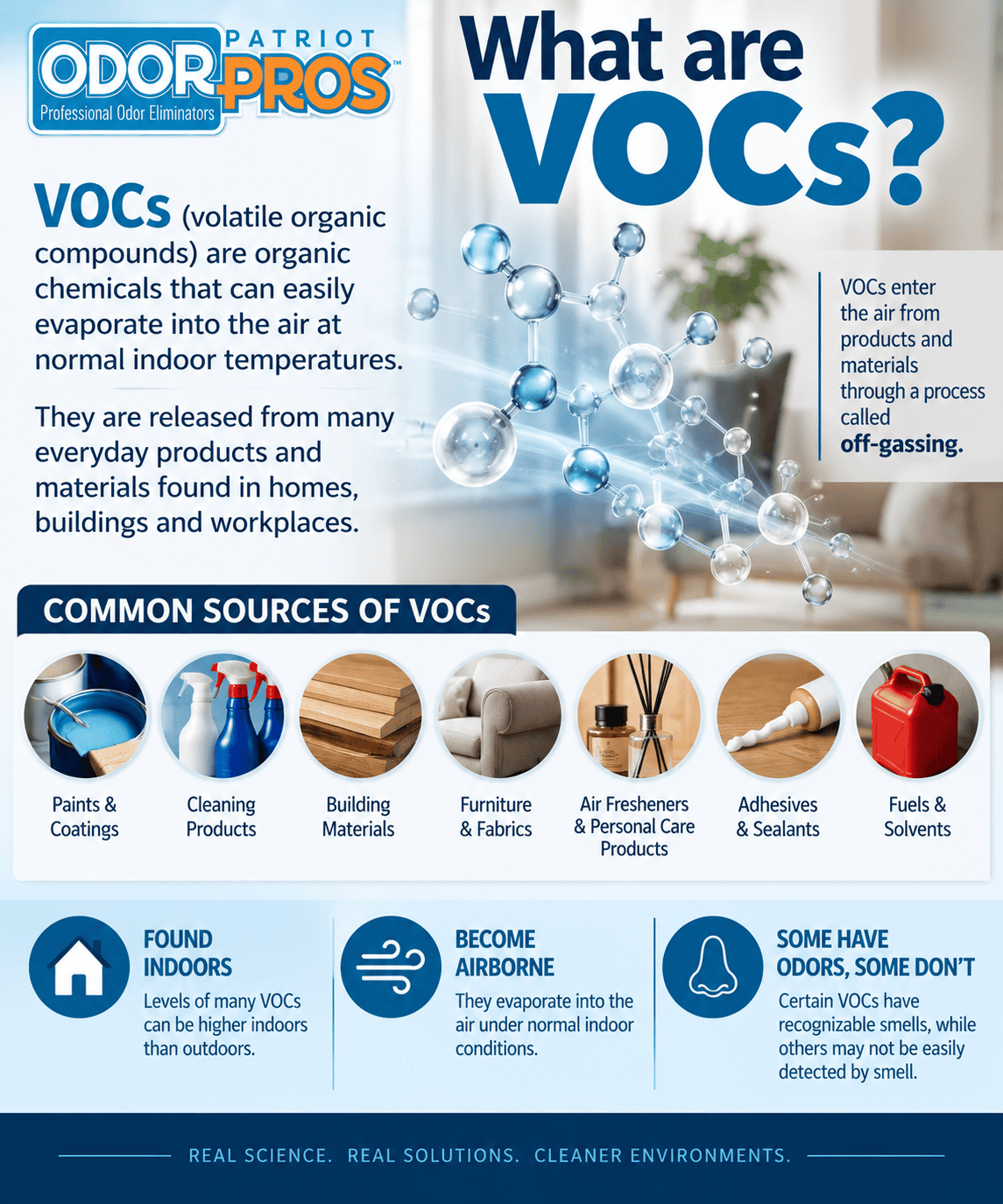
What Exactly Is a VOC?
The acronym VOC stands for volatile organic compound.
Let's break that down.
Organic refers broadly to carbon-containing compounds.
Volatile describes a compound's tendency to enter the gas phase.
Compound simply means a substance composed of particular chemical elements arranged in a defined structure.
Put those concepts together and we get substances that can move from materials or liquids into the surrounding air under ordinary conditions.
This process is often casually called off-gassing, particularly when discussing building materials, furnishings, flooring, adhesives, coatings, or newly manufactured products.
EPA explains that the more volatile a compound is, the more readily it may be emitted from a product or surface into the air.
That's important because the air inside a home is constantly interacting with the materials inside it.
Your house isn't chemically static.
EPA and VOCs

🏡 REALTOR INTELLIGENCE™
The Renovated Listing Problem
Imagine you're preparing a property for market.
The seller has done everything you're normally told makes a home more attractive:
Fresh paint.
New flooring.
New cabinets.
New furniture.
Professional cleaning.
The house looks fantastic.
Then the first buyers arrive.
They walk through the door and say:
“It smells really chemical in here.”
That doesn't automatically mean something is wrong with the house.
But it also shouldn't simply be dismissed.
Recent painting, new furnishings, flooring, adhesives, cabinetry, cleaners and other materials can introduce VOCs into indoor air.
Realtor Tip
When substantial renovations are completed immediately before listing, give materials appropriate time to cure according to manufacturer directions and use proper ventilation where applicable.
And if an unexplained odor persists?
Investigate it rather than attempting to overpower it with fragrance.
Also Read 📖Why Every Odor Has a Source: The Science Behind Finding the Real Problem
Can You Actually Smell VOCs?

This is where things get more complicated.
When homeowners hear “VOC,” they often imagine a harsh chemical smell.
But VOC and odor are not synonymous.
Some airborne chemicals have distinctive odors.
Others may have weak odors.
Some may not be detectable by people at relevant concentrations.
And human odor sensitivity varies substantially from person to person.
That's why smell is useful as an observation tool but limited as an analytical tool.
Your nose might tell you:
Something changed.
It cannot reliably tell you:
Exactly what chemical is present, how much is present, or what risk that concentration represents.
That requires appropriate investigation and, where necessary, environmental testing by qualified professionals.
📋 Realtor Action
During your pre-listing walkthrough, evaluate the home before adding fragrance products.
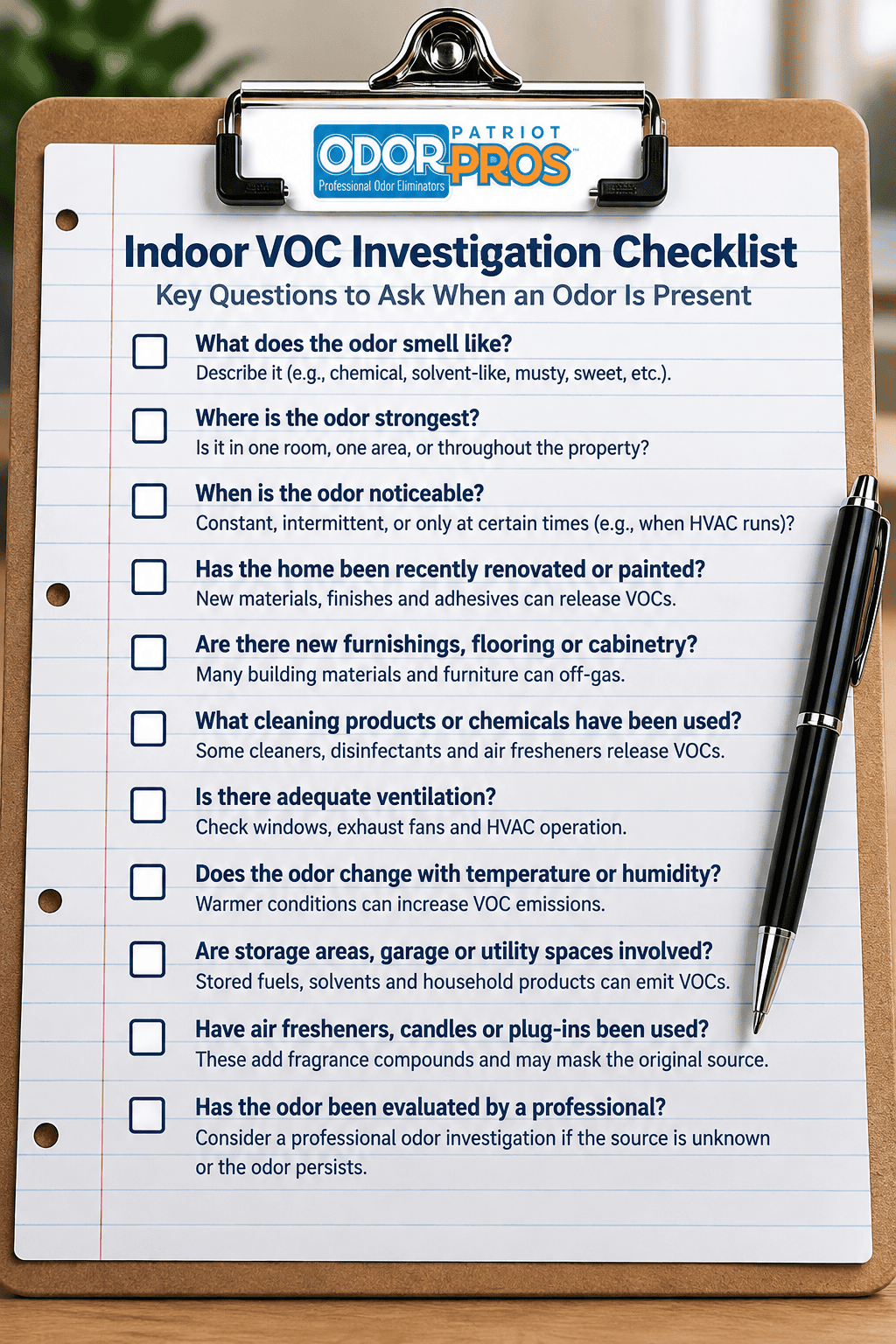
If you notice a persistent chemical, musty, smoky, pet-related, or otherwise unexplained odor, document:
Where is it strongest? When is it noticeable? Is it localized or throughout the property? Has anything recently been painted, installed, cleaned, repaired, or renovated?
Those observations can provide valuable clues when determining the actual source.
Why Odor Strength Doesn't Equal Toxicity
This may be the most important scientific distinction in the entire article.
People instinctively associate:
strong smell = dangerous
and
no smell = safe.
Neither assumption is reliable.
ATSDR explains that health effects from exposure to a substance depend on factors including its concentration, frequency of exposure, and duration of exposure.
The identity of the chemical matters too.
EPA likewise emphasizes that VOCs are a broad group of chemicals and that simply reducing a total VOC measurement doesn't necessarily tell you that one product is safer than another because individual compounds can differ substantially in toxicity.
That gives us an important distinction:
Odor threshold ≠ health threshold.
How easily your nose detects a substance and the concentration at which that substance may create a health concern are two different questions.
Also Read 📖Why Homes Become Nose Blind: The Science Behind Why You Can’t Smell Your Own House
🏠 Realtor's Corner
Never Diagnose a Property by Smell
This is where a little scientific knowledge can protect both the Realtor and the client.
Suppose a buyer says:
“That smell means there's something toxic in here.”
A Realtor shouldn't confirm that conclusion.
But dismissing the concern isn't appropriate either.
A much better response is:
“There is an odor present. Let's determine where it's coming from before we draw conclusions about what it is.”
That's professional.
It's factual.
And it doesn't turn the Realtor into an environmental scientist.
OBSERVE → DOCUMENT → INVESTIGATE
Not:
SMELL → ASSUME → DIAGNOSE
That is Odor Intelligence™ in practice.
Odor Removal Services
When “Fresh and Clean” Adds More Chemistry
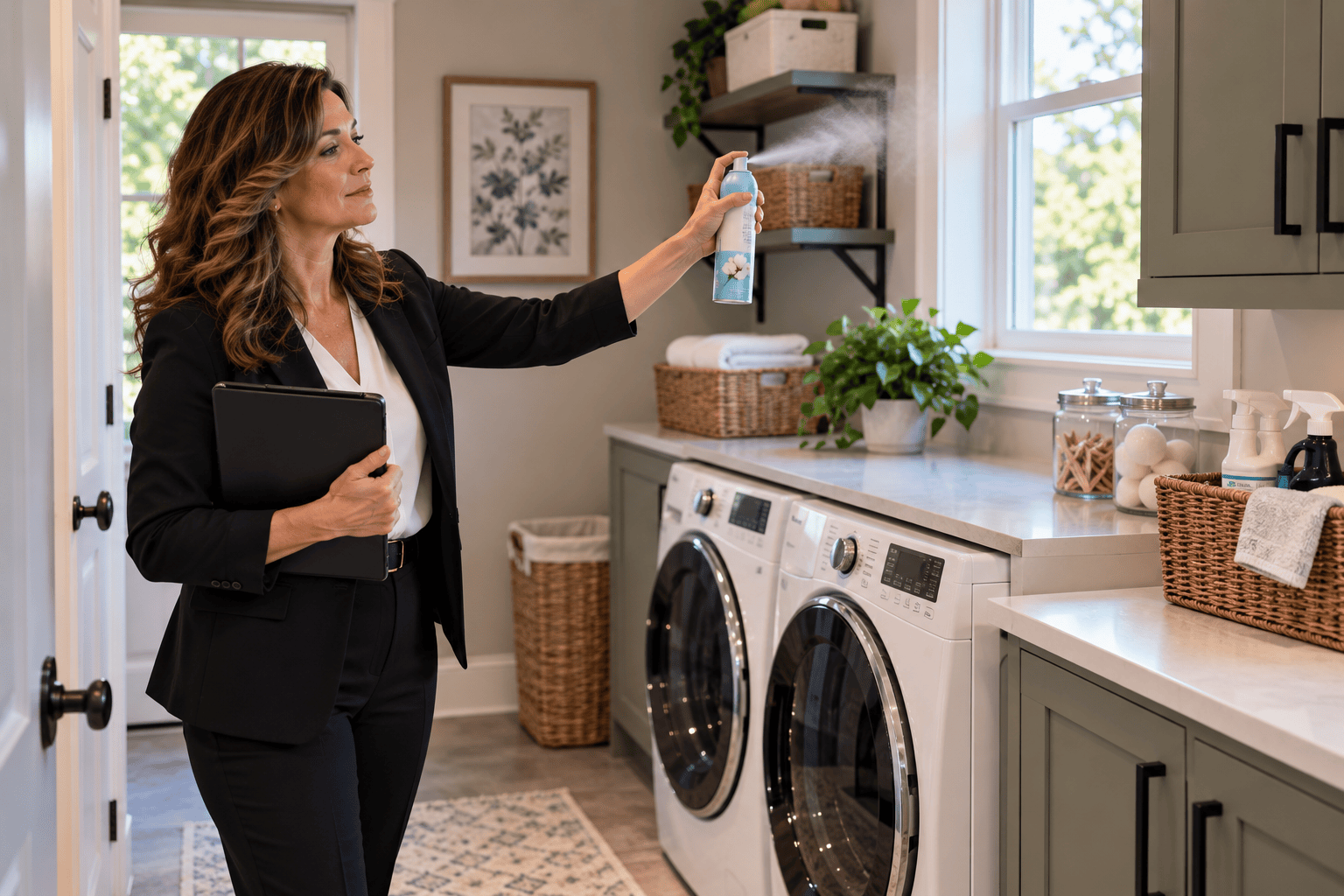
Here's an interesting contradiction.
A seller notices an unpleasant odor before a showing.
So they spray air freshener.
Then they light a scented candle.
Then they clean the counters with a fragranced cleaner.
Then they spray the upholstery.
The original odor may become harder to detect.
But chemically speaking, the seller hasn't necessarily removed anything.
They've introduced additional substances into the indoor environment.
EPA specifically lists air fresheners and many cleaning products among potential sources of VOCs.
This doesn't mean ordinary household products are inherently unsafe when used according to their directions.
It means adding fragrance is not the same thing as removing an odor source.
And from a real-estate perspective, excessive fragrance can create another problem:
Buyers notice it.
Some immediately wonder what the fragrance is intended to hide.
Also Read 📖The Olfactory System Explained Simply | Patriot OdorPros
The Better Question Isn't “What Can I Spray?”
Throughout this Science Library, we've been gradually changing the way we think about odors.
Instead of asking:
“How can I make this smell better?”
we ask:
“Why does this smell exist?”
VOC science reinforces exactly the same principle.
If a room suddenly develops an unusual chemical odor, several questions become more useful than reaching for deodorizer:
What changed?
Was something recently painted?
Was new flooring installed?
Was adhesive used?
Was furniture delivered?
Were strong cleaners applied?
Is a container leaking?
Is the smell strongest in one location?
Does it appear only when the HVAC operates?
Did it begin after renovation?
Those observations create a trail.
And a good odor investigation follows that trail toward the source.
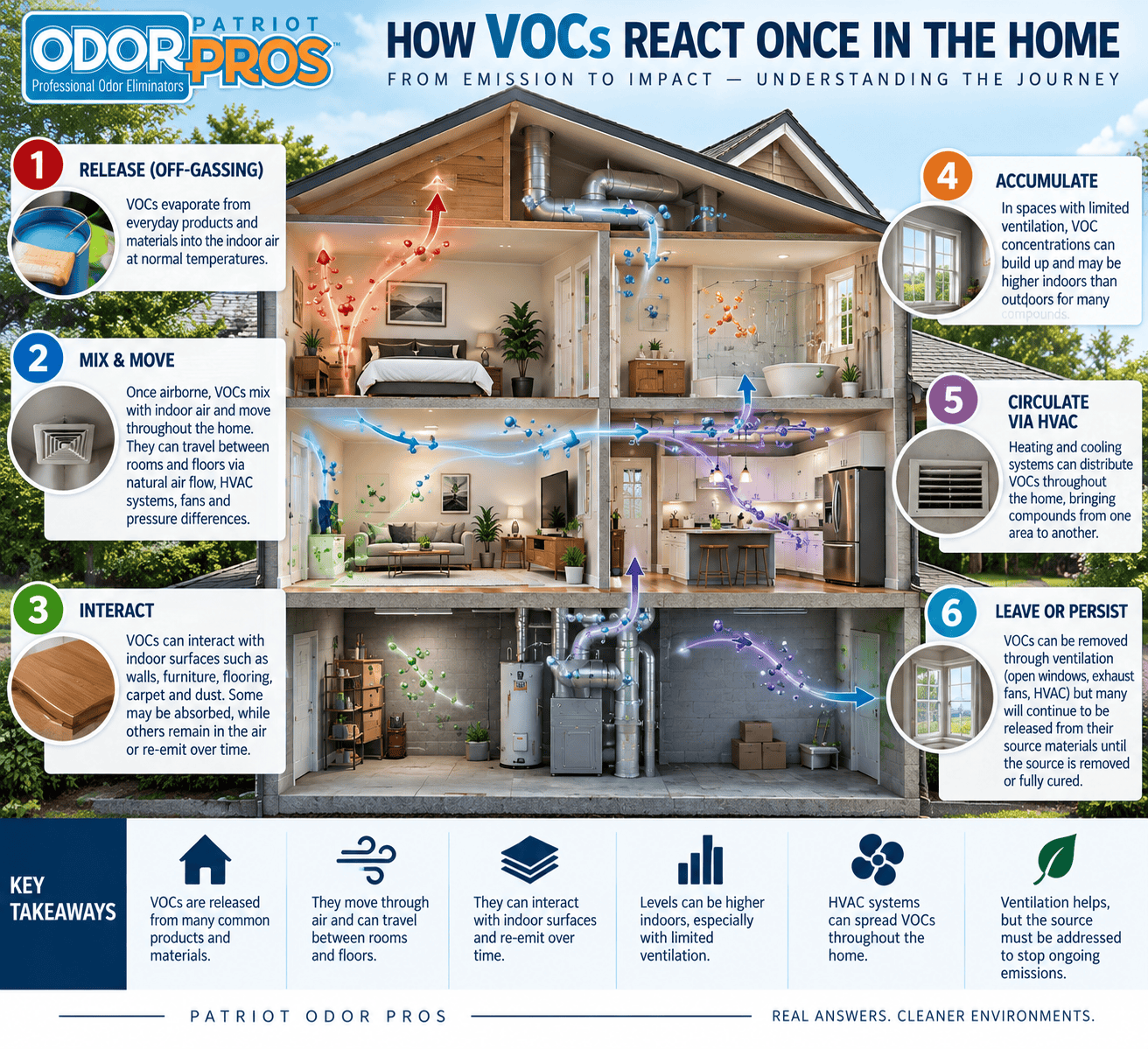
Ventilation Matters—But It Isn't Always the Entire Solution
When VOCs are being emitted by a newly introduced product or material, increasing outdoor-air ventilation can sometimes help reduce indoor concentrations.
That's why ventilation is commonly recommended during activities such as painting and when using certain products, according to their labels and manufacturer instructions.
But there's an important distinction:
Ventilating a room and eliminating a source are not necessarily the same thing.
Imagine new flooring was recently installed.
Opening windows may help exchange indoor air with outdoor air.
But if the flooring, adhesive, coating, or another material continues releasing compounds, the source is still present.
The same principle applies to odors.
If opening the windows makes an odor disappear temporarily but the smell returns after the house has been closed for several hours, that observation is useful.
It tells us something.
The source may still be producing the compounds responsible for the odor.
Also Read 📖Why Musty Smells Mean More Than Moisture
🏡 Realtor Intelligence™
The Closed-House Test
Realtors often experience something homeowners don't:
They enter homes that have been closed for hours—or sometimes days.
That can make the first few moments inside particularly informative.
A homeowner living in the property may have adapted to its normal odor environment. But when a Realtor or prospective buyer enters after being outside, their olfactory system encounters that environment with a relatively fresh perspective.
If you notice an unusual odor immediately upon entering, pay attention to it.
Then ask:
- Does it become less noticeable after several minutes?
- Does opening windows dramatically change it?
- Is it strongest on one floor?
- Is it stronger near cabinets, flooring, utility rooms or recently renovated areas?
- Does it appear when the HVAC system starts?
- Has anything recently been painted, installed or refinished?
- Has the home been heavily cleaned or fragranced before the showing?
These aren't diagnostic questions.
They're investigative questions.
And that's exactly where good Odor Intelligence™ begins.
Industries We Serve
VOCs and the “New House Smell”
Few odors illustrate the complexity of VOCs better than the familiar new house smell.
Many people associate it with:
New. Clean. Updated. Expensive.
But what you're actually smelling may be a mixture of compounds released from numerous newly manufactured or installed materials.
Potential contributors can include:
- flooring,
- carpeting,
- paint,
- coatings,
- adhesives,
- cabinetry,
- furniture,
- sealants,
and other finishing materials.
The important point isn't that a newly renovated home is automatically unsafe.
It isn't.
The important point is that “new smell” is chemistry—not proof of cleanliness or quality.
And different materials release compounds at different rates.
Temperature, ventilation, product composition, the amount of material installed, and time since installation can all influence the indoor environment.
Also Read 📖Smoke Odor Removal Before Selling Your Home in Central Massachusetts | Improve Buyer Confidence
💰 Odor Intelligence™ Market Insight

A Beautiful Renovation Can Still Lose the First Impression
Imagine spending thousands of dollars preparing a house for market.
New floors.
Fresh paint.
Updated cabinets.
Beautiful staging.
Professional photography.
Then a buyer walks through the front door and says:
“What's that smell?”
Suddenly, they're no longer looking at the quartz countertops.
They're investigating the house.
They may begin wondering:
Is there mold?
Is something leaking?
Was there a fire?
Are the floors giving off chemicals?
Was something covered up?
Their conclusions may be completely wrong.
But from a real-estate perspective, something important has already happened:
The buyer's attention has shifted from possibility to uncertainty.
That's why unexplained odors deserve attention before the listing goes live.
When an Odor Appears During a Showing
One of the worst times to discover an odor problem is when the buyer discovers it for you.
If that happens, don't immediately identify the smell unless its source is genuinely known.
Statements such as:
“That's definitely just the new carpet.”
or
“It's nothing—it's probably the cleaning products.”
may sound reassuring, but without investigation, they're assumptions.
Instead, acknowledge the observation.
Something as simple as:
“I notice it too. We should determine what's causing that.”
is much more defensible—and much more useful.
Then begin gathering information.
✅When did the odor begin?
✅What changed in the property?
✅Where is it strongest?
✅Is it constant or intermittent?
✅Does weather affect it?
✅Does HVAC operation affect it?
✅Were new products or building materials recently introduced?
✅Has anyone attempted to cover the odor with fragrance?
Each answer helps narrow the investigation.
Also Read📖 Musty Odor Removal Central Massachusetts | Eliminate Musty Smells at the Source
VOCs Aren't the Only Compounds That Create Indoor Odors
Here's where the science gets even more interesting.
Not every odor problem should simply be labeled a “VOC problem.”
That term has become so familiar that it sometimes gets used as shorthand for practically any chemical smell.
But indoor odor chemistry can be much more complicated.
Odors can arise from substances and processes associated with:
- microbial activity,
- cooking,
- pets,
- smoke,
- moisture-related deterioration,
- drains and plumbing,
- sewage,
- decomposing organic material,
- household chemicals,
- fuels,
- building materials,
- furnishings,
- and numerous other sources.
Some odor-producing substances may be VOCs.
Others may not fit neatly into the way the term is being used in a particular indoor-air discussion.
That's why professional investigation begins with the source, rather than assuming the category of chemical involved.
Also Read📖 Specialty Odor Removal Central Massachusetts | Eliminate Strange Odors for Good
What Are Microbial VOCs?
There is another branch of VOC science that becomes particularly relevant when discussing musty odors.
Microorganisms can produce volatile compounds through metabolic processes.
These are often referred to as microbial volatile organic compounds, or mVOCs.
Certain microbial processes can contribute to odors people describe as:
musty, earthy, damp, stale or mushroom-like.
But this distinction is extremely important:
A musty odor alone does not prove that mold is present.
And smelling a particular odor cannot tell you which microorganism—if any—is responsible.
Instead, a persistent musty odor can be treated as a reason to investigate the conditions that commonly support microbial growth, particularly moisture.
That is a much more scientifically responsible approach.
🏠 Realtor's Corner
Don't Call Every Musty Smell “Mold”
This is an especially important distinction for real-estate professionals.
A Realtor walks into a basement.
It smells musty.
The temptation is to say:
“There's mold down here.”
Don't.
An odor is not a laboratory result, moisture assessment, or professional mold evaluation.
Instead:
“There's a persistent musty odor here. We should determine where it's coming from.”
That distinction protects everyone involved.
It also leads to a better investigation.
Look for the conditions first:
Water intrusion.
Elevated moisture.
Past flooding.
Plumbing leaks.
Condensation.
Wet materials.
Crawl-space moisture.
Poor drainage.
The odor may be the clue that starts the investigation.
It isn't the diagnosis that ends it.
Why Air Fresheners Can Complicate Odor Investigation

Suppose there's an odor in a finished basement.
The homeowner plugs in several air fresheners.
Now the room contains:
the original odor + fragrance.
Then carpet deodorizer is added.
Now there are additional fragrance compounds.
Then a scented cleaner is used.
Now there are even more.
Eventually, the environment may smell strongly “fresh,” but the original source hasn't necessarily changed at all.
This can actually make odor investigation more difficult.
The technician now has to distinguish the original odor from everything that has been introduced to mask it.
For a home entering the real-estate market, this is another reason we prefer:
SOURCE CONTROL OVER SCENT CONTROL.
Property Managers & Landlords
Odor Investigation vs. Environmental Testing
These terms should not be confused.
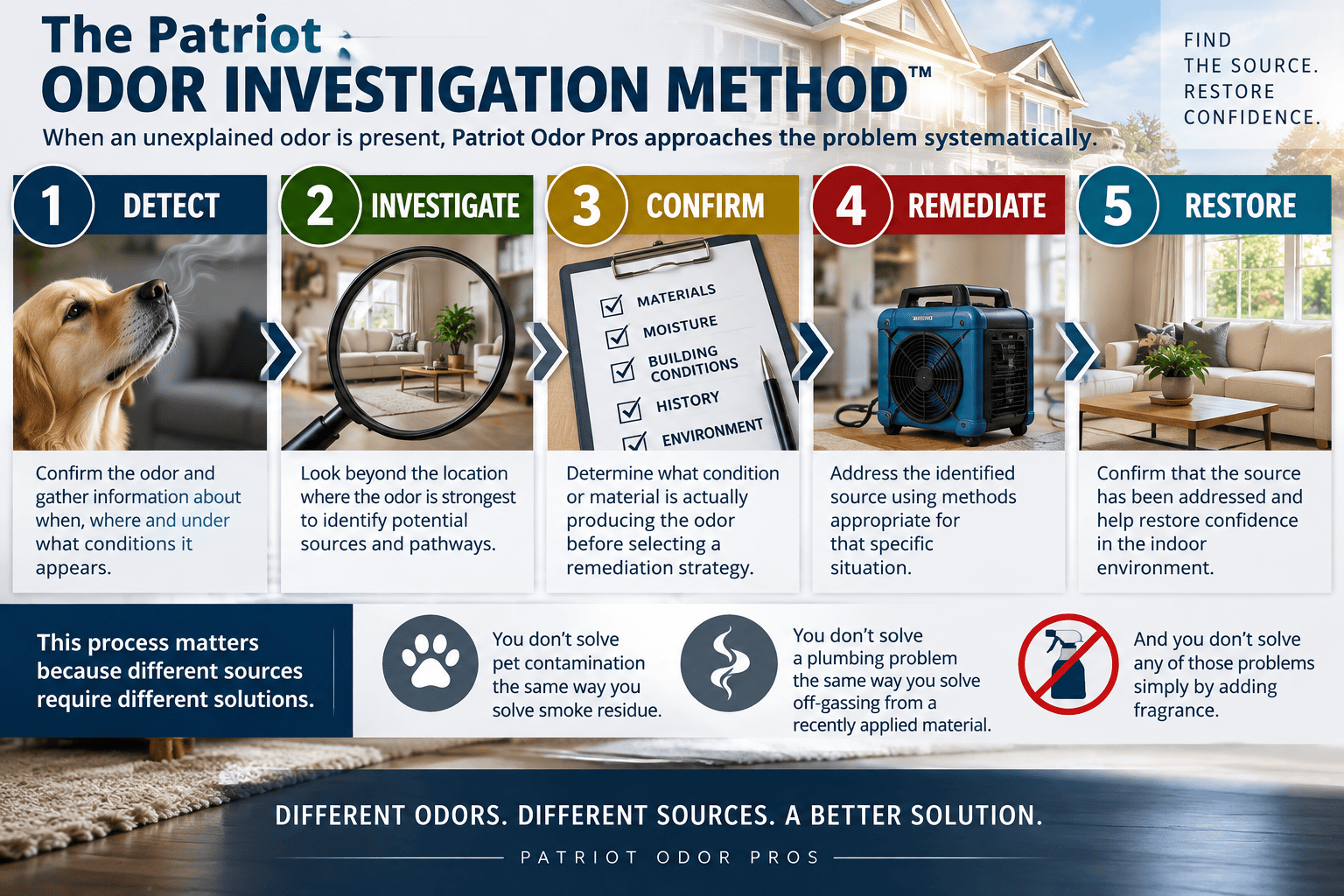
A professional odor investigation is designed to determine where an odor is originating and what conditions may be producing it.
That can involve evaluating:
building conditions,
moisture,
materials,
air movement,
contamination,
odor patterns,
history,
and other evidence.
Environmental testing is different.
Depending on the concern, specialized professionals may collect air or material samples and use laboratory or field instrumentation to evaluate specific contaminants.
Sometimes testing is appropriate.
Sometimes source investigation identifies an obvious problem without needing sophisticated chemical analysis.
The correct approach depends on the situation.
That's why Patriot Odor Pros doesn't begin with:
“We know what that smell is.”
We begin with:
“Let's find out where it's coming from.”
Food & Cooking Odors
🧠 Odor Science Fact
Your Nose Is Remarkably Sensitive—but It Isn't a Laboratory
Human smell is an extraordinary biological detection system.
It can alert us to changes in our surroundings long before we consciously understand what changed.
But odor perception is influenced by many variables, including:
individual sensitivity,
previous exposure,
olfactory adaptation,
the mixture of compounds present,
environmental conditions,
and the concentration of odor-producing substances.
That makes the human nose incredibly useful for recognizing that something is different.
But it does not make smell a reliable method for identifying unknown chemicals or determining exposure risk.
The nose is the alarm bell.
Investigation determines why the alarm is ringing.
Als0 Read 📖The Science Behind Scent and Emotion | Patriot OdorPros
Pet Odor Removal
Why Professional Odor Investigation Matters
Throughout the Patriot Odor Science Library, we've been building toward one central idea:
Odor is information.
Your olfactory system detects airborne molecules and your brain interprets those signals.
Sometimes the source is obvious.
Other times, it isn't.
VOCs add another important layer to that story because they demonstrate just how complex indoor odor chemistry can become.
Some volatile compounds have noticeable odors.
Others may not.
Some odors are detectable at very low concentrations.
And the strength of a smell alone cannot tell you whether an environment is safe or unsafe.
That means homeowners and Realtors shouldn't attempt to diagnose indoor-air conditions based solely on smell.
But they shouldn't ignore persistent unexplained odors either.
That's where professional investigation matters.

At Patriot Odor Pros, our job isn't to walk into your property, spray something stronger than the odor and declare the problem solved.
We want to understand:
What changed?
Where is the odor originating?
What materials or conditions may be involved?
How is the odor moving through the property?
And what needs to happen to address the actual source?
For homeowners, that means getting answers instead of repeatedly trying products that don't solve the problem.
For Realtors, it means addressing unexplained odors before buyers are standing in the doorway asking questions.
For property managers, it means solving the underlying issue instead of repeatedly responding to the same complaint.
And when a situation falls outside the scope of odor remediation and requires specialized environmental testing or another professional discipline, recognizing that distinction matters too.
Because every odor has a source, every odor has a solution—and every solution begins with finding the source.
If a persistent chemical, musty, smoky, pet-related or unexplained odor has you wondering what's really happening inside a property, contact Patriot Odor Pros for a professional odor investigation.
Don't mask the evidence. Find the source.
☎️Contact Us / Get a Quote

Frequently Asked Questions
1. What does VOC mean?
VOC stands for volatile organic compound. It describes a broad category of organic compounds that can enter the air as gases under ordinary environmental conditions.
2. What are common sources of VOCs inside homes?
Potential sources include paints, coatings, adhesives, cleaning products, air fresheners, furnishings, building materials, fuels, solvents and many other household products.
3. Can you smell VOCs?
Some VOCs produce odors people can detect, while others may not be readily detectable by smell. Smell alone cannot determine which compound is present.
4. Does a strong chemical smell mean the air is dangerous?
Not necessarily. Odor strength alone cannot establish toxicity or exposure risk. The specific substance, concentration, duration and frequency of exposure are among the factors that matter.
5. Does having no odor mean there are no VOCs?
No. Some VOCs may be present without producing an odor that a person notices.
6. What causes “new house smell”?
New paint, flooring, cabinetry, adhesives, furnishings, coatings and other recently manufactured or installed materials can release volatile compounds that contribute to the characteristic odor associated with new or renovated spaces.
7. Can air fresheners remove VOCs or household odor sources?
Air fresheners are generally intended to add or modify fragrance. They do not necessarily remove the underlying material or condition producing an unwanted odor.
8. Can mold or bacteria produce VOCs?
Microorganisms can produce volatile compounds during metabolic processes. These are often called microbial volatile organic compounds, or mVOCs. However, odor alone cannot identify the organism responsible or prove that mold is present.
9. What should a Realtor do if a property has a chemical or unexplained odor?
Document where and when the odor appears, ask about recent renovations or product use, avoid diagnosing the cause, and consider professional investigation when the source isn't apparent.
10. When should I call Patriot Odor Pros?
If an odor is persistent, keeps returning after cleaning, appears to move through the property, has an unknown source, or could interfere with the comfort, use or sale of a property, a professional odor investigation can help identify what is actually producing it
Previous article: Why Musty Smells Mean More Than Moisture
Next article: Understanding Bacteria and Odors
